

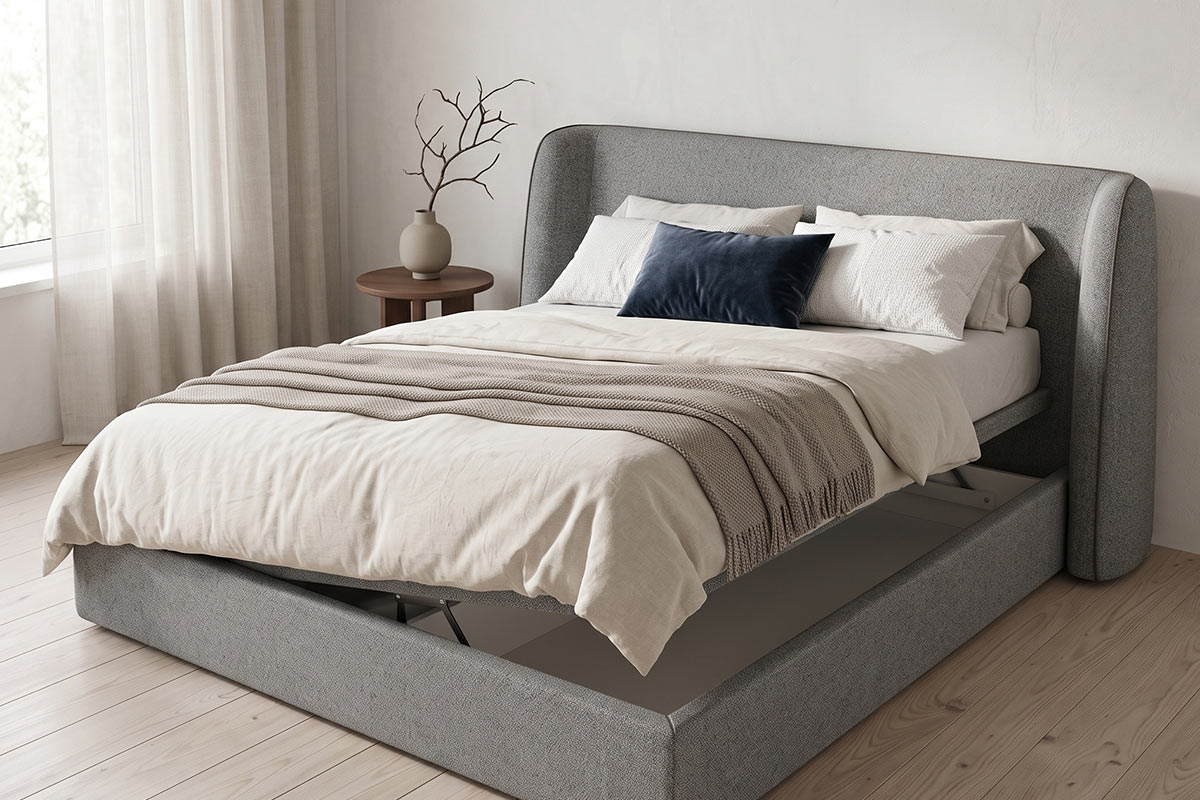
When buying a box-spring bed, a practical question inevitably arises sooner or later: should you go for one with a storage compartment or not? The difference affects not only storage space, but also the height of the bed, the price, ventilation and how easy the bed is to clean. Those who base their decision solely on appearance often overlook which option suits their bedroom and everyday life best. This guide explains where the real differences lie and when the extra cost of a storage base is worth it – and when it isn’t.
The difference lies in the base
A box spring bed always consists of several layers: a base unit with a spring core or pocket spring core, a mattress on top and, in most cases, a topper for added comfort. The storage base is not a separate design in itself, but an additional function of the base unit – instead of a fixed box with legs or a plinth, the lid lifts up to reveal storage space. Externally, both variants usually look very similar; the difference only becomes apparent on closer inspection and in everyday use.
Box spring bed without a storage base: when it’s the better choice
Without a storage compartment, the sleeping height is generally lower because the base can be constructed flatter. This is particularly noticeable in rooms with low ceilings or sloping roofs. This version is also usually cheaper than the one with a storage compartment, as it does not require the lifting mechanism or the reinforced construction for the lid.
Anyone who already has sufficient storage space in the room – such as a walk-in wardrobe or a large chest of drawers – rarely benefits from the extra space under the bed. For these households, a box spring bed without a storage base is the simpler solution: it is easier to clean, usually lighter in weight and has no moving parts that require maintenance over time.
Box spring bed with storage: when the extra cost is worth it
In small bedrooms or guest rooms without a separate wardrobe, a storage base is often the only way to create extra storage space without adding another piece of furniture. Bed linen, duvets or seasonal clothing can be tucked away under the mattress whilst still remaining within easy reach.
On most models, the lid is lifted by a gas spring, so that the storage compartment can be opened with minimal effort even when the mattress is in place. This mechanism is an industry standard for under-bed storage and works regardless of the bed’s upholstery or design. The trade-off: the overall height increases, and the bed becomes heavier overall.
What to look out for when making your decision
In practice, four factors usually determine the choice:
- Ceiling height and window sill: A taller bed can be impractical in rooms with low window sills or sloping ceilings.
- Actual storage space requirements: A storage bed is only worthwhile if it is used regularly – otherwise, it is simply wasted space.
- Budget: A bed with storage usually costs more – the extra cost is only worth it if you genuinely need the storage space.
- Who makes the bed: When airing the room and changing the bed linen every day, a bed without storage is quicker to manage because there is nothing to lift.
The layout of the room also plays a role. If the bed stands freely in the room and is accessible from both sides, a bed with a storage compartment can be opened without any problems. If, on the other hand, it is positioned with one side against the wall or under a window, there should be enough space to lift the lid.
Care and ventilation for both types
An open bed base with a continuous slatted frame allows more air to circulate than a closed storage bed. This affects the mattress’s moisture regulation: anyone who sweats a lot or sleeps in a rather damp room should take particular care to air the mattress regularly and use a breathable mattress protector when using a bed base with a storage compartment. Regardless of the variant, the following applies: the mattress and topper should be lifted slightly or turned over every few weeks to prevent moisture from building up.
When it comes to cleaning, the version without a bed base has a practical advantage – the floor underneath can be reached with a flat-head vacuum cleaner if the bed stands on legs. A storage bed, on the other hand, sits flush with the floor, so no dust collects under the bed, although the interior of the storage compartment itself should be wiped down occasionally.
Box spring bed with vs. without storage: a comparison
| Criterion | Without a storage compartment | With storage compartment |
|---|---|---|
| Sleeping height | Lower | Higher, due to storage box and mechanism |
| Storage space | No additional storage space | Additional storage space under the mattress |
| Price | Usually cheaper | Usually more expensive due to the mechanism and construction |
| Ventilation | Better air circulation with an open slatted base | More restricted due to the enclosed box |
| Cleaning | The floor beneath the bed is accessible when the bed is raised on legs | No dust under the bed; clean the interior occasionally |
| Weight | Usually lighter | Heavier due to additional components |
Why Maison de Cocon
- Box spring beds from Maison de Cocon are available both with and without a storage base, so the choice depends on your actual storage needs.
- Covers, toppers and mattress firmness levels can be combined independently of the base frame.
- The design is modular, which makes it easier to transport through narrow stairwells and into rooms.
- Pre-purchase advice takes into account room dimensions and ceiling height, not just the desired look.
Beds & Mattresses · Which mattress is right for your box spring bed?


Leave a comment
All comments are moderated before being published.
This site is protected by hCaptcha and the hCaptcha Privacy Policy and Terms of Service apply.