

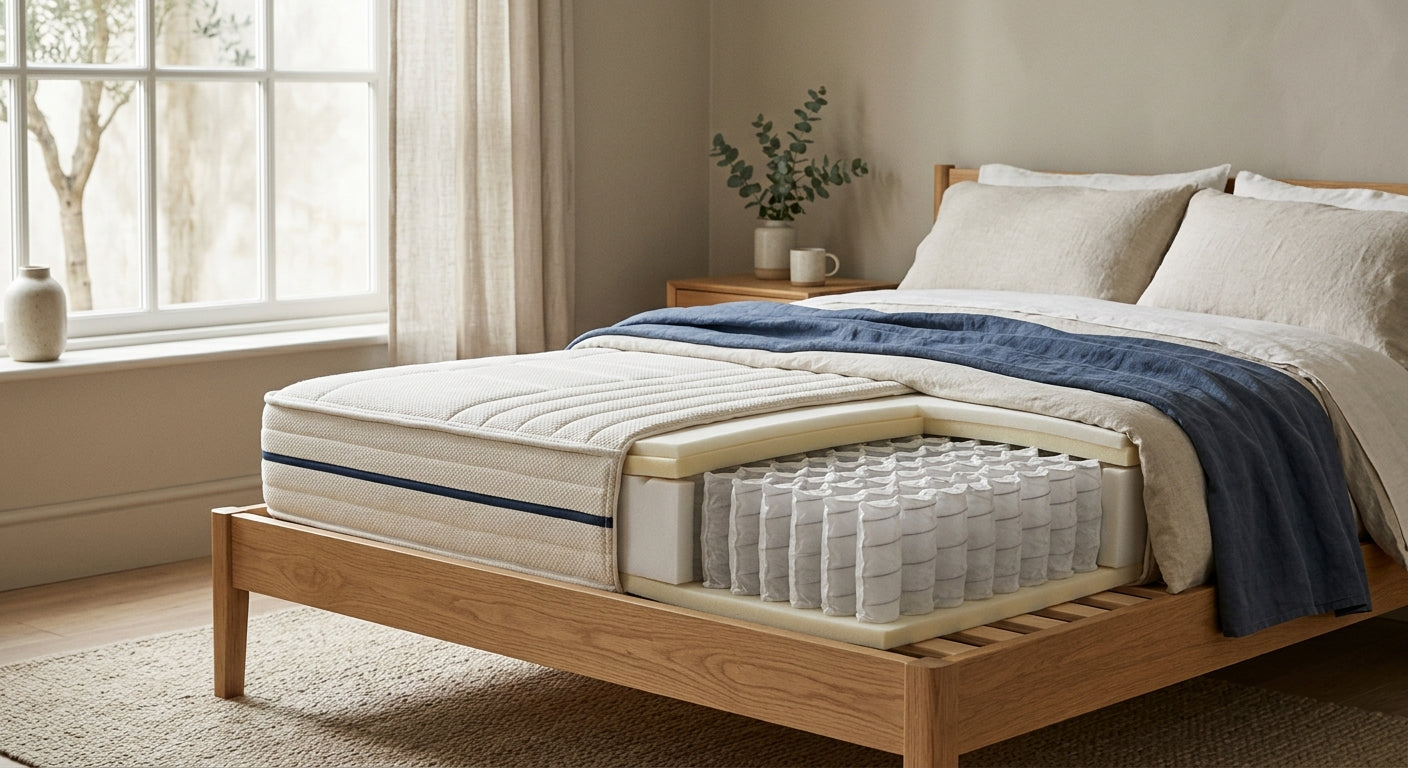
The firmness level of a mattress is primarily determined by body weight—and with good reason. A heavier body sinks deeper and requires more counter-pressure to keep the spine aligned than a lighter profile. While categories H1 through H5 offer a baseline reference from soft to extra firm, weight is only one component of a thoughtful decision. Body build, sleep position, and the core material of the mattress play equally essential roles. This guide outlines how firmness scales align with weight, where to locate the rating on your mattress, and what structural choices support spinal health during back recovery.
A brief glance at the label is typically all that is required to identify a mattress's firmness: H1, H2, H3, and beyond. This classification system coordinates directly with body weight. Sleeping on a surface that is too forgiving causes the pelvis or shoulder region to sag, forcing the spine out of alignment overnight. Conversely, an overly rigid surface limits pressure distribution, leading to localized tension or morning discomfort. While weight serves as an unhurried starting point, it remains part of a broader set of considerations.
An overview of firmness categories H1 to H5
The standard division into five distinct firmness levels has become widely established, providing clear structural guidance across manufacturers even without official normalization. The spectrum begins at H1 for exceptional softness and concludes at H5 for extra firm support. Between these points lie H2 (medium), H3 (medium-firm), and H4 (firm)—the configurations most frequently specified, as they comfortably support the vast majority of adult profiles.
- H1 – soft, typically recommended for body weights up to approximately 60 kg
- H2 – medium, suited for individuals between 60 and 80 kg
- H3 – medium-firm, calibrated for weights between 80 and 100 kg
- H4 – firm, engineered for weights between 100 and 120 kg
- H5 – extra firm, designed for profiles from 120 kg upward
These ranges represent thoughtful guideposts rather than absolute boundaries. Two individuals sharing identical weight metrics may find they require entirely different firmness levels to settle comfortably.
Firmness reference matrix by body weight
The matrix detailed lower down this page aggregates the standard industry correlations. Treat these figures as a preliminary benchmark rather than an absolute selection—variations in body proportions and preferred sleeping postures regularly shift the ideal choice by a full category.
Why weight alone remains insufficient
Two individuals weighing 85 kg can present completely different shoulder or hip proportions, varying heights, and unique resting postures. A side sleeper with broad shoulders often benefits from choosing one level softer than a back sleeper of the same weight, allowing the shoulder area to sink appropriately so the spine rests horizontally. Conversely, those who sleep on their stomach regularly require a firmer foundation to prevent the midsection from sagging uncomfortably.
Furthermore, the structural composition of the mattress core alters how firmness is perceived. Cold foam, traditional springs, and natural latex respond uniquely to compression, even when sharing identical firmness ratings. A medium-firm H3 cold foam mattress will present a distinct tactile feedback compared to an H3 pocket spring model, as the underlying materials distribute pressure and return support at different rates.
Where to locate the firmness rating on your mattress
The firmness specification is standardly noted on a woven label sewn along the perimeter seam of the mattress cover, typically positioned adjacent to the care instructions. Certain manufacturers additionally print this designation on the protective packaging or product hangtag. Should the label be missing or trimmed away, the original product specifications sheet or purchase invoice generally lists the selected firmness variant.
Firmness considerations for back discomfort and disc recovery
When addressing a herniated disc or managing chronic back discomfort, consulting with an orthopedist or physical therapist remains an essential step before selecting a specific firmness level. Standard retail generalizations fall short in these scenarios, as correct anatomical support depends strictly on the affected spinal region, regular sleeping posture, and individual physical history. Professionally, a medium to medium-firm foundation is frequently suggested to stabilize the back without straining isolated pressure areas—though the definitive choice must be tailored to your specific medical profile.
When partners require distinct firmness profiles
For couples presenting noticeably different body weights, a single uniform firmness setting rarely accommodates both individuals adequately. A tailored solution involves zoned mattresses that offer varying compression resistances across their surface, or arranging two separate mattresses of differing firmness levels side-by-side beneath a single shared cover on a double slatted frame. Additionally, specific slatted bases allow the independent tension of individual zones to be calibrated separately for each side of the bed to balance weight variations.
Determining the correct firmness profile in practice
Testing a bed for a few brief minutes in a showroom rarely reveals how a mattress handles hours of continuous rest. A home evaluation spanning several weeks yields far more reliable feedback as you monitor how your body responds over time. Waking with numbness in the arms indicates excessive resistance and a surface that is too firm. Experiencing a dull ache in the lower back suggests the pelvis is sinking too deeply, meaning a step up in firmness may offer better support.
Beds & Mattresses · in our guide to mattress types and core materials
Mattress Firmness Guidelines by Body Weight
| Body Weight | Firmness Level | Classification |
|---|---|---|
| up to approx. 60 kg | H1 | soft |
| approx. 60–80 kg | H2 | medium |
| approx. 80–100 kg | H3 | medium-firm |
| approx. 100–120 kg | H4 | firm |
| from approx. 120 kg upward | H5 | extra firm |
Why Maison de Cocon
- Our portfolio presents mattresses across multiple firmness levels, allowing you to select a baseline matched to your weight and sleeping posture.
- Every mattress features an integrated firmness label on the cover edge, ensuring absolute clarity regarding its technical specifications.
- Our customer care team provides measured guidance to assist your decision whenever you find yourself navigating between two adjacent categories.
- Our mattresses and slatted frames are designed to be paired independently, letting you select structural firmness and sizing completely separate from each other.


Leave a comment
All comments are moderated before being published.
This site is protected by hCaptcha and the hCaptcha Privacy Policy and Terms of Service apply.