

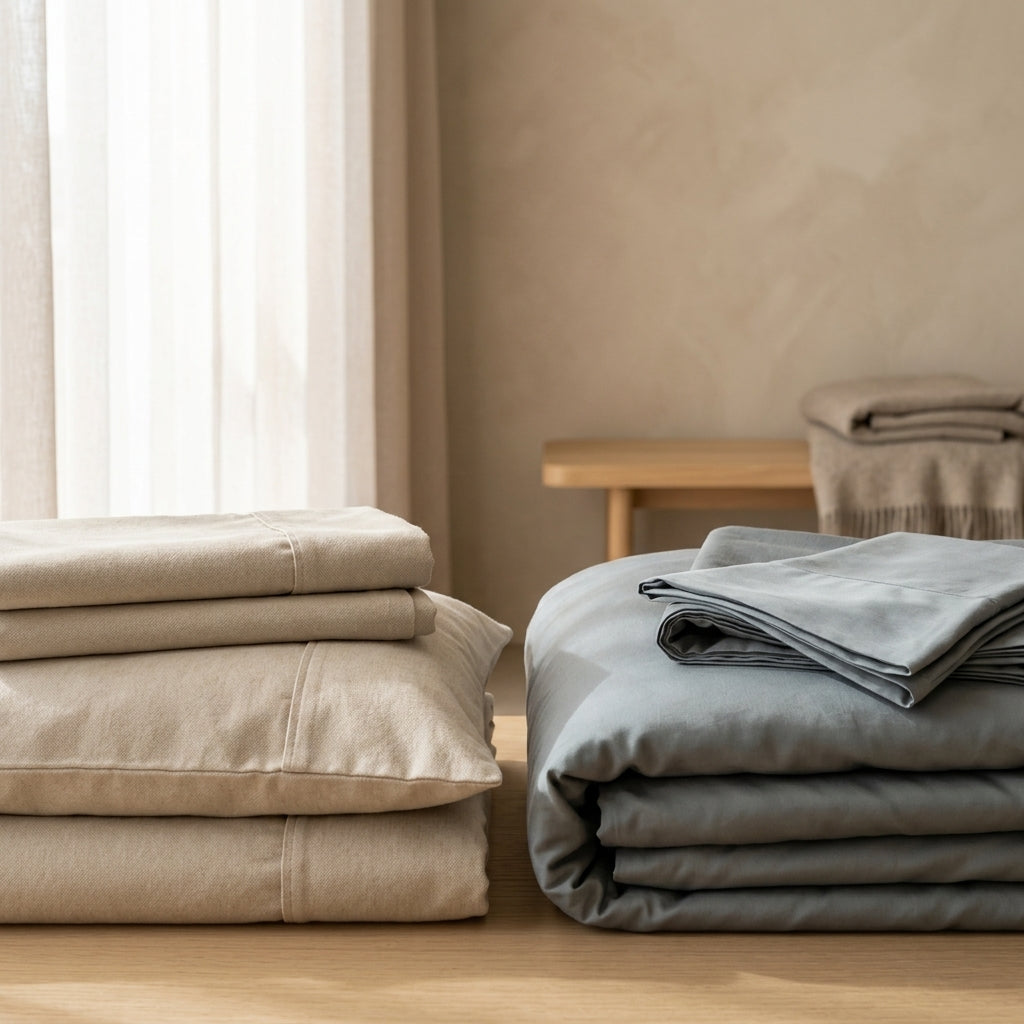
Many people regard thread count as the most important indicator of quality in bed linen – yet it is only half the story. The figure simply describes how many threads are woven per square inch, but says nothing about the raw material, yarn quality or workmanship. Furthermore, once a certain threshold is reached, manufacturers often resort to using multi-ply yarns to artificially inflate the count. This guide explains what the thread count actually measures, why percale and satin feel completely different even with the same count, and what you should really look out for when making a purchase.
What the thread count actually measures
The thread count indicates how many warp and weft threads are woven into an area of one square inch (approximately 6.45 cm²). A thread count of 200 therefore means 200 threads per square inch – counting both the warp and weft threads. The term originates from the American textile industry and has become established internationally as a benchmark for cotton fabrics.
On its own, however, the thread count says little about how a fabric feels or how long it will last. It is a measure of the fabric’s density, not of yarn quality, raw material or workmanship.
Why a high thread count does not automatically equate to quality
From around 400 onwards, it becomes technically difficult to fit in any more individual threads without overloading the fabric. Manufacturers therefore resort to a trick: they twist several thin yarns together to form a thicker thread – known as a multi-ply yarn – and count every single filament. This results in figures of 800, 1,000 or even 1,500 – values that bear little relation to the actual feel of the fabric.
A single-ply yarn made from long-staple cotton often produces a finer, smoother fabric than a multi-ply yarn made from short-staple cotton, even with the same thread count. The staple length of the fibre – how long it is before it is spun – has a greater influence on softness than the thread count alone.
Percale or satin: the weave determines the feel
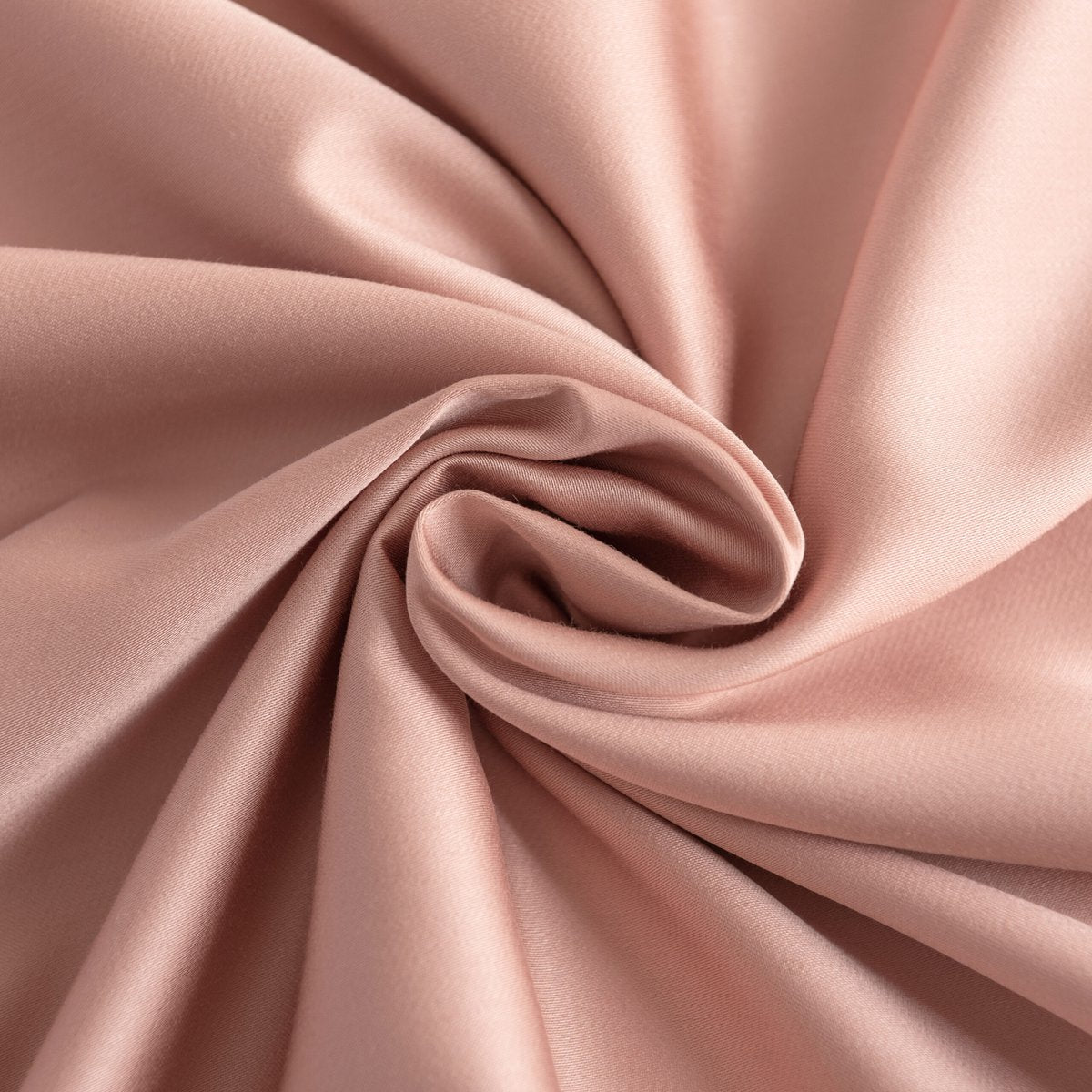
As well as the thread count, the weave determines how bed linen feels. Perkal is woven in plain weave: the warp and weft threads cross in a simple alternation, resulting in a matt, cool, crisp and fresh fabric reminiscent of a freshly ironed shirt. Satin, on the other hand, is woven in a satin weave, in which a weft thread runs over several warp threads before dipping back under. This leaves more of the yarn’s surface exposed; the fabric has a slight sheen and feels noticeably smoother and heavier.
Both weaves are available in different thread counts. A 200-thread-count percale feels different from one with a 300-thread-count – but a 300-thread-count satin feels fundamentally different from a percale with the same thread count. Anyone who compares thread counts alone, without taking the weave into account, is ultimately comparing two different things.
A common misconception in advertising
In advertising, the thread count is often used as a mark of quality, much like the wattage rating on vacuum cleaners: a high number makes an impression without saying anything about actual performance. For buyers, this means one thing above all: without details on the type of cotton, fibre length and yarn construction, the thread count remains an isolated figure that can hardly be compared with a competing product.
Thread count in everyday life: Which range is suitable for what
For percale bed linen, a good quality range is usually between 180 and 300. Below this, the fabric quickly appears thin and see-through; above it, the typical percale character – light, matt, breathable – is increasingly replaced by a denser, warmer feel. With satin, good qualities are often between 300 and 600, although from around 400 onwards, multi-ply yarns are increasingly used to boost the count further.
Anyone who sweats at night or lives in a bedroom without air conditioning is usually better off with lower thread counts in percale weave – the fabric is more airy. Those who prefer a heavier, glossier feel are more likely to find this in satin with a medium to high thread count.
What you should look out for when buying instead
The thread count is a guide, but not the sole indicator of quality. The following details are usually more meaningful:
- The type of cotton and fibre length – long-staple cotton has a greater influence on softness than the thread count.
- Whether the yarn is single-ply or multi-ply – this information is often missing from labels, but reputable manufacturers will provide it on request.
- The weave – percale for a fresh, matt feel; satin for sheen and weight.
- The workmanship – neat, flat seams and carefully finished edges last longer than roughly finished ones.
A simple practical test can also help: when rubbed between your fingers, high-quality bed linen should feel smooth and supple, without feeling papery or having an artificial sheen.
Care affects how long the quality remains noticeable
Even the highest thread count is of little use if it isn’t cared for properly. Cotton bed linen is generally washed at 40 to 60 degrees; higher temperatures damage the fibre structure and cause the fabric to thin out more quickly. High spin speeds and intense heat in the tumble dryer have a similar effect. Washing bed linen gently and not drying it at too high a temperature significantly extends the fabric’s lifespan, regardless of the original thread count.
Thread count comparison
| Thread count range | Typical weave | Feel | Suitable for |
|---|---|---|---|
| 80–140 | plain weave | sturdy, slightly rough | Everyday laundry, holiday homes |
| 180–300 | Percale | matt, crisp and fresh, cool | Suitable for all seasons, for people who sleep warm |
| 300–400 | Percale or satin | smooth, silky | Suitable for all seasons, for those with discerning tastes |
| 400–600 | Satin (partly multi-ply yarns) | very smooth, lustrous, heavier | Cooler bedrooms, sturdier feel |
| over 600 | mostly multi-ply yarns | The figure is often not proportional to the feel | Caution: check material specifications carefully |
Why Maison de Cocon
- In our bed linen collection, we specify the weave and fabric composition for every item, so that you can compare products regardless of the thread count alone.
- We stock both percale and satin bed linen, so you can choose according to your preferred feel.
- Care instructions are provided with every product to ensure the fabric quality is maintained even after many washes.
- Our range is based on standard bed sizes, so you can find duvet covers that fit standard dimensions.
Bed linen · Percale or satin – the difference in bed linen


Leave a comment
All comments are moderated before being published.
This site is protected by hCaptcha and the hCaptcha Privacy Policy and Terms of Service apply.