


A summer duvet is meant to keep you cool, a winter duvet to keep you warm — but what's actually behind that? The real difference lies in the fill weight, the fill material, and the cover fabric, not in colour or appearance. If you're sweating in summer or freezing in winter, you're often simply using the wrong warmth class. In this guide, we explain how to recognise summer, winter, and combination duvets, which materials make sense for which season, and how to find the right duvet for your bedroom and your personal warmth needs.
Why summer duvets and winter duvets work differently
During sleep, the body continuously releases heat and moisture. A duvet should balance this process rather than amplify or block it. In summer, the body needs a duvet that lets excess heat escape; in winter, it needs one that retains it.
The key differences between summer and winter duvets
Three factors determine how warm or cool a duvet feels: the amount of fill, the material used, and the density of the cover fabric. All three are connected, but they don't affect warmth to the same degree.
Fill weight and warmth class
Duvets are often categorised into warmth classes, typically on a scale from 1 to 4, sometimes extended with a class 5 for particularly warm models. Class 1 stands for very light, cooling duvets, while class 4 stands for duvets with high heat retention. Fill weight increases with the warmth class: summer duvets are comparatively lightly filled so warm air can escape, while winter duvets are filled much more densely to retain body heat. Importantly, fill weight is always relative to the specific duvet size — a 200x200 cm duvet needs more fill than a 135x200 cm duvet to reach the same warmth class.
Fill material: natural fibre or synthetic fibre
Down and feathers are classic natural fillings. They offer a good warmth-to-weight ratio and are breathable, which makes them suitable for both light summer duvets and warm winter duvets, depending on the fill weight. Wool regulates moisture particularly well, which is why it's often used in transitional and winter duvets. Silk is frequently used in summer duvets because it feels cool and releases moisture quickly. Synthetic fillings made from polyester or microfibre are generally easier to care for, usually machine washable at 60 degrees, and a practical alternative for anyone who prefers to avoid animal-derived materials.
Cover fabric and construction
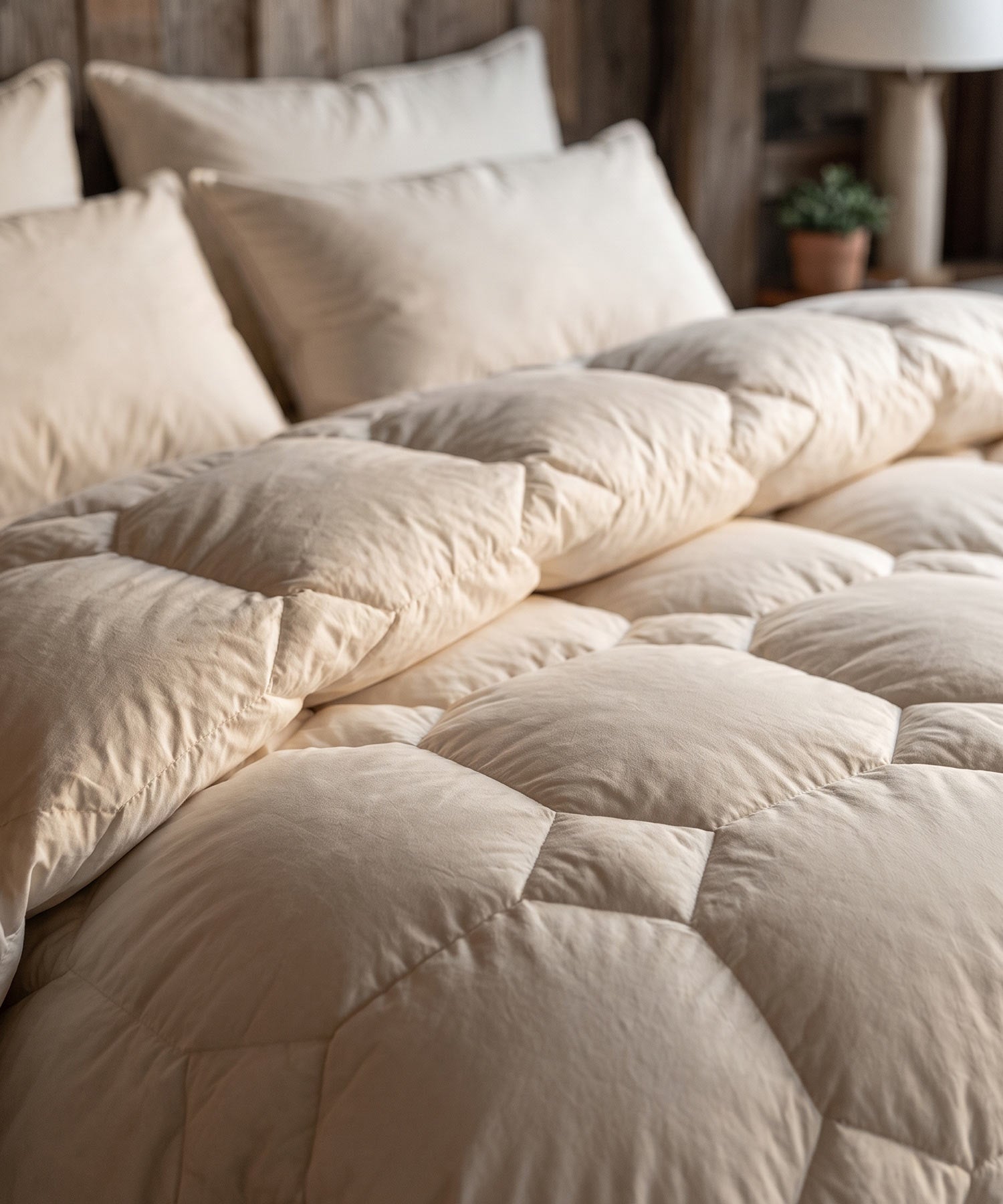
The fabric enclosing the fill also affects sleep temperature. Summer duvets are often covered in lighter, more openly woven cotton fabrics such as percale, which allow air to circulate. Winter duvets tend to use more densely woven fabrics such as cotton satin, which let less air through and therefore insulate better. The quilting — the seams that hold the fill in separate chambers — also plays a role: larger chambers let the fill move more freely, while smaller ones create a more even, often warmer distribution.
The combination duvet: one duvet for several seasons
If you'd rather not switch between two separate duvets, a combination duvet — often called a 4-season duvet — is a practical solution. It consists of two individual duvets of different warmth classes that can be joined together at the corners and edges using a button strip or snap fasteners. In summer, you use only the lighter duvet; in winter, both together; in spring or autumn, the warmer single duvet is often enough on its own. The advantage is flexibility: one purchase covers three to four different warmth needs throughout the year, without having to keep several completely separate duvets in the cupboard.
Which duvet suits your bedroom?
Room temperature while sleeping is the most important starting point. In well-heated or poorly ventilated bedrooms, a lighter duvet is often enough, while cool, well-ventilated rooms justify a warmer fill. Personal sensitivity to temperature also matters: if you tend to feel the cold or sweat more than most at night, weigh that more heavily than the season alone when choosing a warmth class. In a shared bed with different warmth needs, it's common to use two individual duvets instead of one large shared one — that way, each person can choose their own warmth class without pulling at the duvet during the night.
Care: keeping summer and winter duvets fresh for longer
Care instructions vary considerably depending on the fill, regardless of whether it's a summer or winter duvet. Synthetic-fill duvets are usually machine washable at 60 degrees, while natural fillings such as down or wool often require gentler washing or professional cleaning, as indicated on the care label. A removable duvet cover reduces how often the duvet itself needs washing, extending its lifespan. Regular airing — ideally overnight or for a few hours by an open window — also helps release moisture from the fill and preserve its loft.
Summer Duvet vs. Winter Duvet Compared
| Feature | Summer Duvet | Winter Duvet | Combination Duvet (4-Season) |
|---|---|---|---|
| Warmth class | 1–2 (light) | 3–4 (warm to very warm) | combinable from light to warm |
| Fill weight | low, for heat dissipation | high, for heat retention | two duvets with different weights |
| Cover fabric | thinner, more openly woven, e.g. percale | more densely woven, more insulating, e.g. satin | varies depending on the individual duvet |
| Ideal for | warm nights, summer | cold nights, winter | transitional seasons or year-round use |
Why Maison de Cocon
- Our Duvets & Pillows collection includes summer, winter, and combination duvets in the standard sizes 135x200 cm and 155x220 cm.
- Combination duvets can be joined using a button strip or snap fasteners, so a single set covers several seasons.
- The cover fabrics are breathable and machine washable, making everyday care easier.
- Our customer service team can help you choose the right warmth class if the product details alone aren't enough.

Leave a comment
All comments are moderated before being published.
This site is protected by hCaptcha and the hCaptcha Privacy Policy and Terms of Service apply.